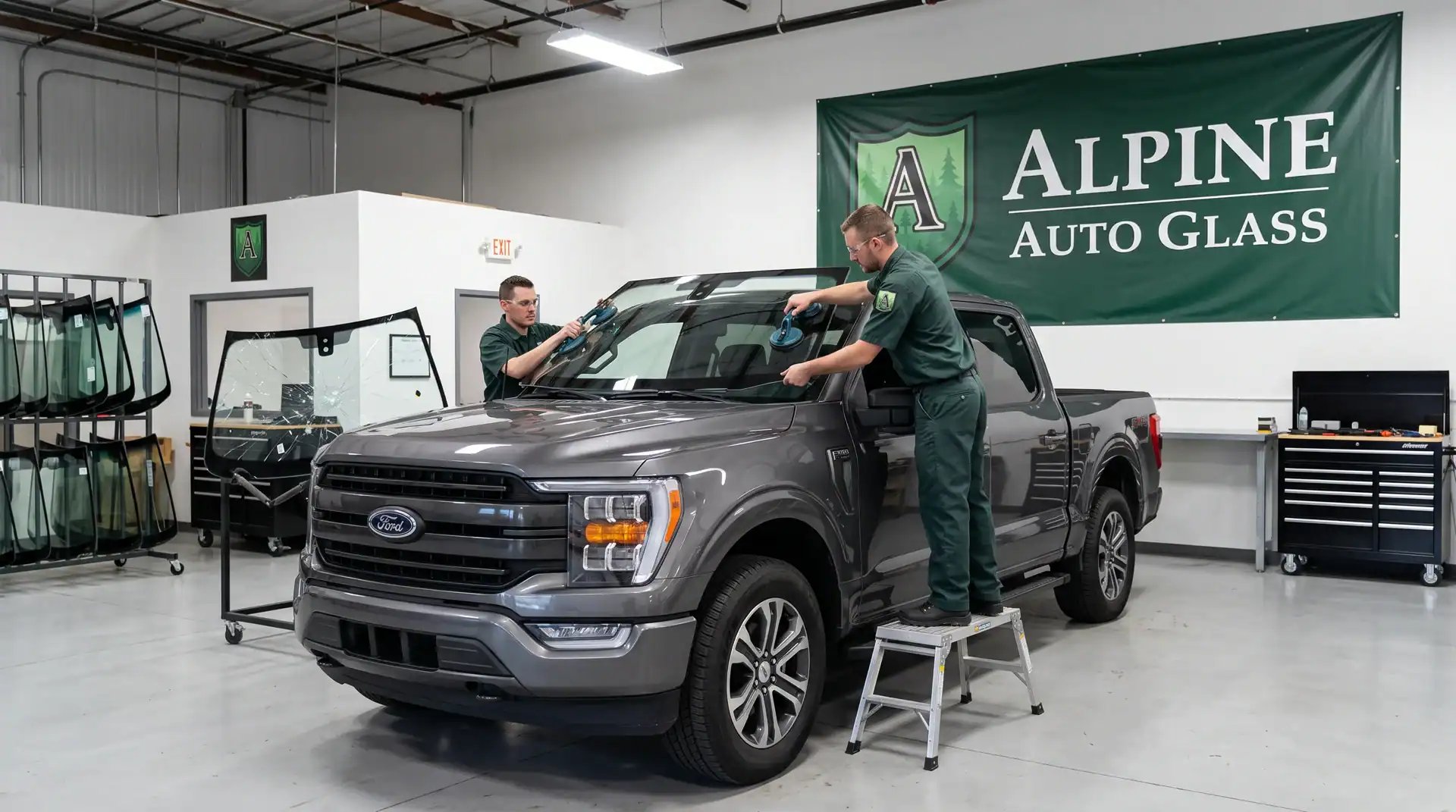
Your windshield replacement isn’t the grand finale. It’s halftime.
If your vehicle has lane-keep assist, forward collision warning, adaptive cruise, or auto high beams, the windshield isn’t “just glass”—it’s the mounting and viewing platform for all of your ADAS sensors and cameras.
If you swap the glass and skip calibration, you’ve basically told your safety systems to start freelancing with bad inputs.
Commercial auto glass customers in particular don’t need more “maybe” risks rolling around in their company parking lots—especially when the fix is a standard, repeatable procedure that gets the car back to OEM-spec behavior – often in less than an hour.
Your New Windshield Changes the Camera’s View
Modern ADAS cameras don’t see “the road.” They see the road through your windshield. Which means the windshield is part of the optics—angle, clarity, bracket position, and even tiny distortions.
After a windshield replacement, the camera might be sitting a few millimeters off, or looking through slightly different glass curvature. Sounds small. It isn’t. ADAS math is allergic to “close enough.”
You shouldn’t care how pretty the install looks from the outside. If the camera’s view is even slightly off, lane-keep can ping-pong you inside the lane. Adaptive cruise control can misjudge following vehicle distance, and auto emergency braking can get jumpy—or go quiet when you need it.
What ADAS Calibration Actually Does for You
Calibration isn’t a ceremonial button-push. It’s the vehicle’s way of re-zeroing its understanding of where “straight ahead” is, what “distance” looks like, and how its camera aligns with the chassis.
Think of it like this: you aren’t replacing a window—you’re replacing a lens in a measurement system. The camera bracket gets removed and reinstalled, the glass is new, and the system needs to confirm its reference points. That’s why we often see OEM procedures call for calibration after windshield replacement on almost all late-model vehicles.
The process is somewhat technical. A proper shop uses a scan tool (Autel MaxiSYS is common) to confirm ADAS faults, read requirements, and run the calibration routine.
Depending on the vehicle, calibration can be:
- Static: the car sits on a level surface while targets/pattern boards are positioned at exact distances and heights in front of the vehicle (systems like Bosch DAS or Hunter setups exist for this).
- Dynamic: the car is driven under specific conditions so the system can learn and validate using real road inputs.
And no, “it’ll relearn on its own” isn’t a plan. It’s what people say when they don’t own the equipment or don’t want the responsibility. Same energy as “we didn’t torque the lug nuts, but they’ll probably tighten up while you drive.”
Skipping Calibration Is a Quiet Liability Issue
When calibration gets skipped, the failure mode isn’t always a dramatic dash light. Sometimes the system stays “on” and just performs worse.
A vehicle that looks fine, drives fine, and then makes one bad call at speed is not safe.
Inaccurate sensor readings can lead to late braking, false alerts, inconsistent lane centering, or an adaptive cruise control that can’t maintain a smooth distance. Even if nobody gets hurt, one incident can cost you days of repair time, claims, disputes, downtime, and the internal headache of figuring out what happened.
The cost of inaction could mean every windshield replacement you ship without calibration is a liability coin flip you didn’t need to flip. And you don’t get a refund on stress.
Static and Dynamic Calibration Are Two Different Jobs
Some vehicles require static calibration only. Others require dynamic only. Plenty require both.
A shop that only offers one method will force your car into their workflow, not the OEM’s. That’s backwards—and it’s how “done” turns into “done-ish.”
A Provider Who Won’t Calibrate Is Selling Half a Repair
You’re going to hear two pitches in the market.
Pitch one: “We replace glass. For calibration, go to the dealer.” That’s the playbook when they don’t want to invest in tooling, training, and process control. It also guarantees extra scheduling, extra downtime, and a higher chance that something gets missed between vendors.
Pitch two: “We replace glass and return the vehicle with ADAS verified.” That provider either has in-house calibration capability or a tightly managed partner workflow, and they treat calibration as part of the same job—because it is.
If you’re vetting a shop for windshield replacement on an ADAS-equipped vehicle, ask four questions and listen closely to the answers:
- Do you perform OEM-spec ADAS calibration after replacement for my year/make/model?
- Do you run a pre-scan and a post-scan, and can you provide the results if I ask?
- Is calibration done static, dynamic, or both, and what triggers the decision?
A competent shop answers cleanly. A sloppy shop changes the subject.
Why Alpine Auto Glass Runs Calibration Like a Safety System
Alpine Auto Glass treats calibration as non-negotiable because the work doesn’t stop when the urethane cures. ADAS is part of the vehicle’s safety stack now, and pretending otherwise leads to a “fixed” windshield but degraded vehicle capability.
This is also where Alpine’s operator mindset comes into play. Mobile service with no convenience upcharges within the service area keeps vehicles moving. Same-day service for emergency calls placed before 2 PM means you’re not losing time for a piece of glass.
And when the job involves advanced systems—lane-keep, collision detection, adaptive cruise—Alpine handles OEM-spec recalibration instead of punting you to a third party.
Windshield replacement used to be simple. Pop the glass, set the glass, send it.
ADAS changed the rules. Now the windshield is part of a sensor system, and calibration is the step that makes the system trustworthy again. Skip it, and you’re not saving money—you’re buying uncertainty, then acting surprised when uncertainty comes to collect interest.
Get the glass replaced. Then finish the job like you actually plan to keep people safe.
If you want Alpine Auto Glass to handle your windshield replacement and ADAS calibration end-to-end, send your year/make/model, the service location, and which driver-assist features you have (lane-keep, adaptive cruise, etc.). If it’s an insurance claim, include the carrier and claim number—and we’ll handle the rest.