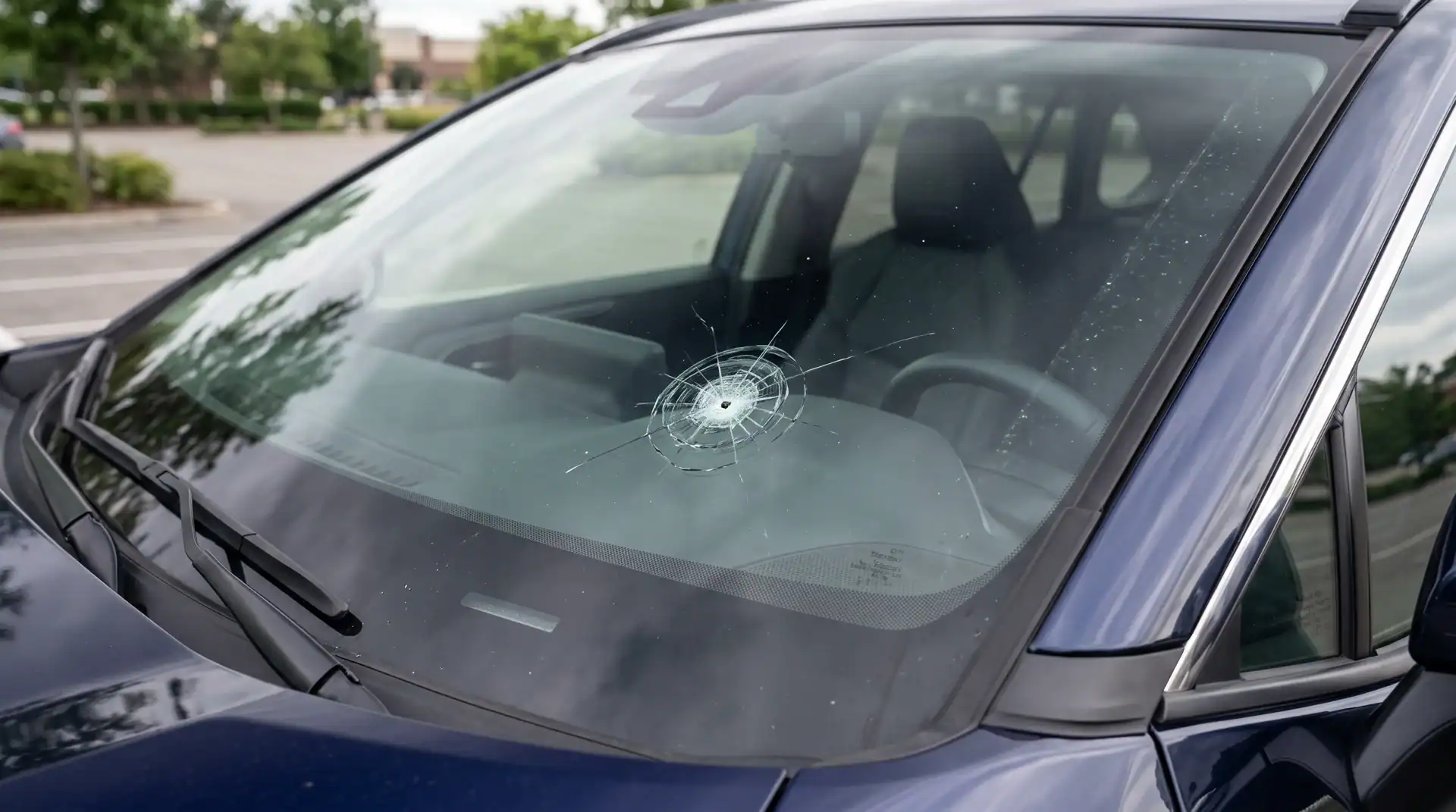
That rock chip you picked up from a gravel truck off Highway 95 isn’t the real problem.
The week you’ve spent ignoring it is.
Most Hayden drivers think the repair-or-replace question comes down to how the chip looks today. It doesn’t. It comes down to size, location, and how many cold mornings pass before someone injects resin into your glass.
We’ve laid out the criteria that separate a 30-minute repair — often $0 with comprehensive coverage — from a full replacement with ADAS recalibration on top.
The Clock Decides Things, Not Your Rock Chip
A repairable chip and a replacement-grade crack are usually the same piece of damage at two different ages. That’s the part almost nobody tells you.
Here’s the mechanism. Your windshield is made of two layers of glass laminated together with a plastic interlayer. A chip is a wound in the outer layer. Every temperature swing makes the glass expand and contract around that wound, and the stress concentrates at the chip’s edges. Eventually it finds a path and runs.
In North Idaho, this math can get brutal.
On any normal 28-degree morning in Hayden, a frosted windshield and a defroster set to high are the two most common ways a quarter-sized chip becomes a 14-inch crack before you reach Government Way. The thermal shock does in four minutes what summer would take months to do.
So the honest answer to “is it still repairable” is usually: yes, today. Maybe not Friday.
The Size and Location Test You Can Run in Your Driveway
Walk out to your vehicle and check the damage against four criteria. This is roughly the same screen we run on the phone before dispatching a tech.
Size: a chip smaller than a quarter, or a crack shorter than 6 inches, is almost always repairable. Past 6 inches, resin can’t restore enough structural integrity, and replacement is the right call.
Location: damage directly in the driver’s line of sight is a judgment call even when it’s small. Repairs leave a faint blemish — fine on the passenger side, a problem when it sits between your eyes and the road.
Depth: if you can feel the damage on the inside of the glass, both layers are compromised. That’s a replacement, no exceptions.
Edge distance: damage within about 2 inches of the windshield’s edge fails the test even when it’s tiny. More on that next, because this is the one everyone gets wrong.
Why a Tiny Edge Chip Beats a Big Center Chip to Replacement
Perhaps it seems a bit counterintuitive, but it’s true: that dime-sized rock chip near the edge of your windshield might be more dangerous than a quarter-sized one that struck your windshield dead center.
The edge is where glass bonds to the frame, and it’s where structural stress concentrates. Any cracks that start near the edge will typically spread faster, run longer, and compromise the windshield’s role in roof-crush protection. A center chip might sit stable for weeks. An edge chip can start to run overnight.
If your rock chip is within a couple inches of the perimeter, stop reading and call a shop. That one doesn’t wait.
The Insurance Math Nobody Explains Until It’s Too Late
This is where waiting gets expensive, and it has nothing to do with the glass.
Most comprehensive policies in Idaho and Washington waive the deductible entirely for rock chip repair. Insurers do it because a repair costs them a fraction of a replacement — they want you to fix it early. So the repair window is also the $0 window. We verify coverage in under five minutes and bill the carrier directly.
Once the chip cracks, you’re into replacement territory, which is likely a full deductible situation on most policies. Plus a second complication most drivers don’t see coming.
If your vehicle is 2018 or newer, the camera behind your windshield runs lane-keep assist and collision detection. Replacement means that camera gets disturbed, and it needs OEM-spec recalibration afterward — a step plenty of shops quietly skip.
One more thing, since the steering scripts are persistent: your insurer might recommend a shop. They cannot require that you choose a specific one. In Washington and Idaho, you get to pick.
What a Repair Actually Fixes and What It Won’t
Worth setting expectations, because a repair is structural, not cosmetic.
A tech drills into the damage if needed, pulls a vacuum to extract air and moisture, then injects resin and cures it with UV light. Done right, it stops the crack from spreading and restores most of the glass’s integrity. The whole thing takes 30 to 60 minutes, and at Alpine, it happens in your driveway in Hayden with no mobile fee.
What repairs don’t do is make the old rock chip completely invisible.
Expect a small scuff-like surface where the damage once was. If someone promises a repair that disappears entirely, they’re probably upselling you something.
The goal for us is a windshield that holds, not one that looks good on Instagram.
The Move for Hayden Drivers with a Bad Crack
Run the driveway test today. Smaller than a quarter, away from the edge, outer layer only, out of your sightline — that’s a repair, and probably a free one. Anything that fails the test is already a replacement; waiting just adds risk.
If it calms down, try to get it scheduled before the next hard frost.
We’ve seen plenty of rock chips that were a $0 fix on Tuesday, only to become a full replacement by the next cold Saturday morning because of one defroster blast. The damage doesn’t negotiate with your calendar.
Five minutes on the phone with us tells you which side of the line you’re on, and what your insurance covers. The chip is the cheap version of this problem. Keep it that way.
Got a rock chip from your 95 commute? Call Alpine Auto Glass — we’ll verify your coverage in under five minutes and can usually have a mobile tech at your Hayden driveway the same day.