When a shop tells you your RV windshield doesn’t exist anymore, they usually mean it didn’t come up in their supplier catalog on the first search. That’s a different sentence. One is a fact about the glass; the other is a fact about how much time somebody was willing to spend on a low-margin job.
RV windshields live in that gap, and it’s why a 1997 Bounder or a curved-glass Class A that’s been parked for two seasons gets a polite no from four shops in a row. Alpine takes those calls.
Your Part Number Isn’t Missing, but Inventory Volume Is
A two-piece curved windshield for a 1998 diesel pusher might sell four units nationally in a year for most distributors. That means nobody wants to stock it.
The glass-making process that made your specific curvature was probably retired when the coach builder folded or changed suppliers years ago.
So now the remaining inventory sits scattered across salvage yards, RV glass fabricator sites, and maybe a handful of distributors in the Northwest who specialize in low-volume laminated panels.
None of that shows up in a standard NAGS lookup a glass tech runs when you call. The system returns nothing, and “nothing” gets read as “discontinued.” What it really means is that the glass isn’t in the normal channel. Finding it takes phone calls, not a search box.
Why Curved Laminated Glass Breaks the Normal Playbook
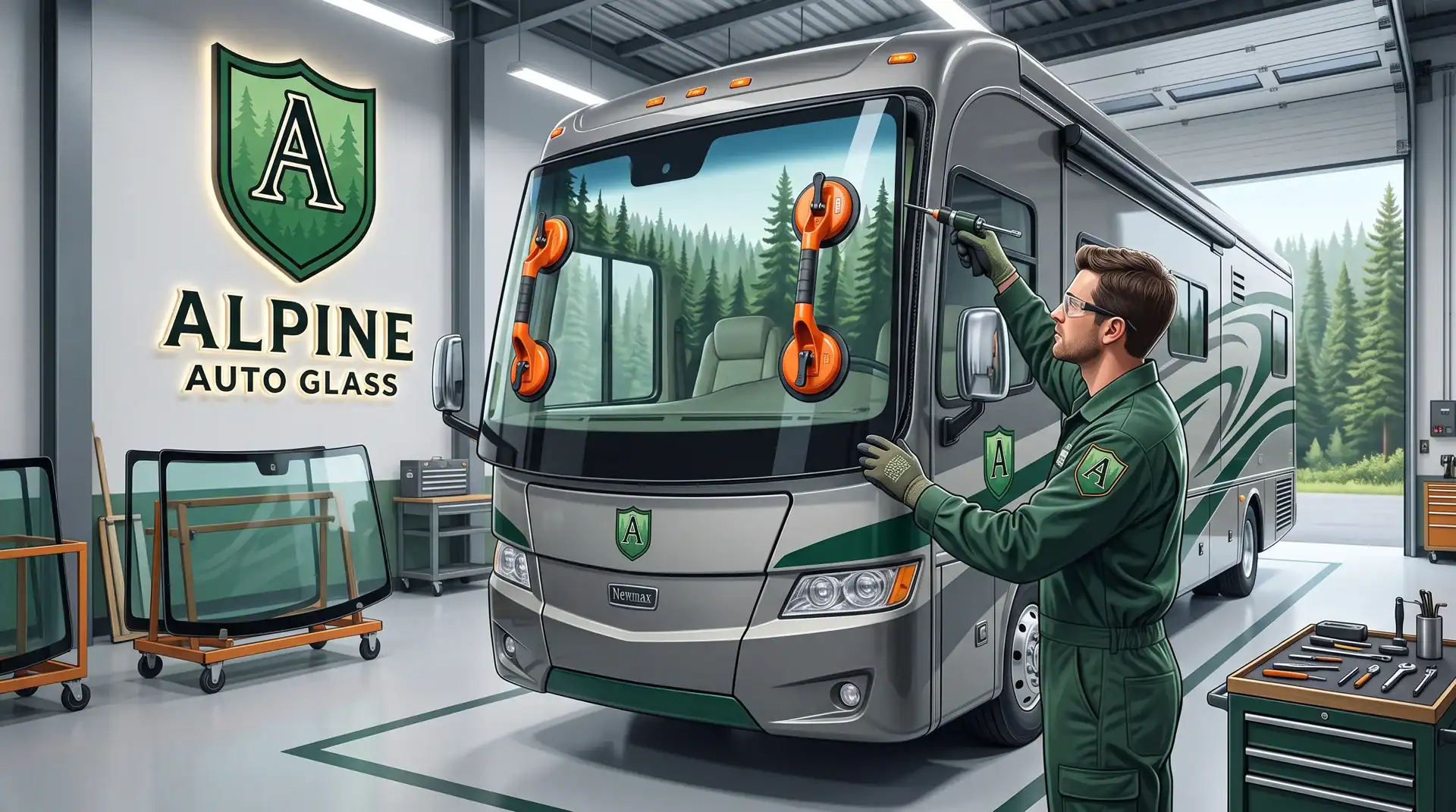
RV windshields aren’t just bigger car windshields. On most Class A coaches,, the glass is two separate curved panels split by a center post, each laminated and bent to a curvature specific to that chassis and body year—sometimes specific to a single production run.
That curvature is the problem. A flat or mildly curved automotive panel can be cut and edged from stock sheet in a fabrication shop. A deep-bend RV panel requires a mold. If the mold is gone, no amount of money produces a new one for a one-off job, and you’re now hunting existing inventory or a fabricator willing to run a small batch.
RV glass is set in with a rubber gasket that uses a locking bead, not urethane-bonded like a car. Set the gasket wrong, and you can get water intrusion at the top corners that you won’t notice until the headliner stains.
What Sourcing Actually Looks Like When the Catalog Says No
Coach builders typically buy the vehicle chassis from Ford, Freightliner, Spartan, and Workhorse, then build their own front cap on top.
However, the chassis VIN doesn’t actually tell us what RV windshield your rig uses.
So we have to work backward from the coach builder, model, floor plan year, and a measured template of the opening itself—height, width, curvature depth, and the DOT stamp in the corner of the old glass, if any of it survived.
The DOT stamp is often the best path because it labels the original maker.
RV-specific glass fabricators often salvage inventory from coaches totaled on insurance claims. Then distributors quietly hold discontinued laminated stock because they know somebody will eventually turn up and ask for it. That process runs anywhere from a few days to a few weeks. It isn’t fast, and we say so up front instead of quoting you a date we’d have to walk back.
Turned Away Once Usually Means Turned Away Four Times
Vintage motorhome owners tend to arrive here already frustrated. They’ve called the chains, gotten the catalog answer, called two independents, gotten the same answer, and started reading forum threads about cutting Lexan to fit.
Don’t do that. Laminated glass isn’t a preference on a windshield — it’s the structural and safety spec, and a polycarbonate substitute scratches, yellows, and fails in a rollover. It also kills resale on a coach somebody spent three years restoring.
The Real Cost of Waiting on Cracked RV Windshields
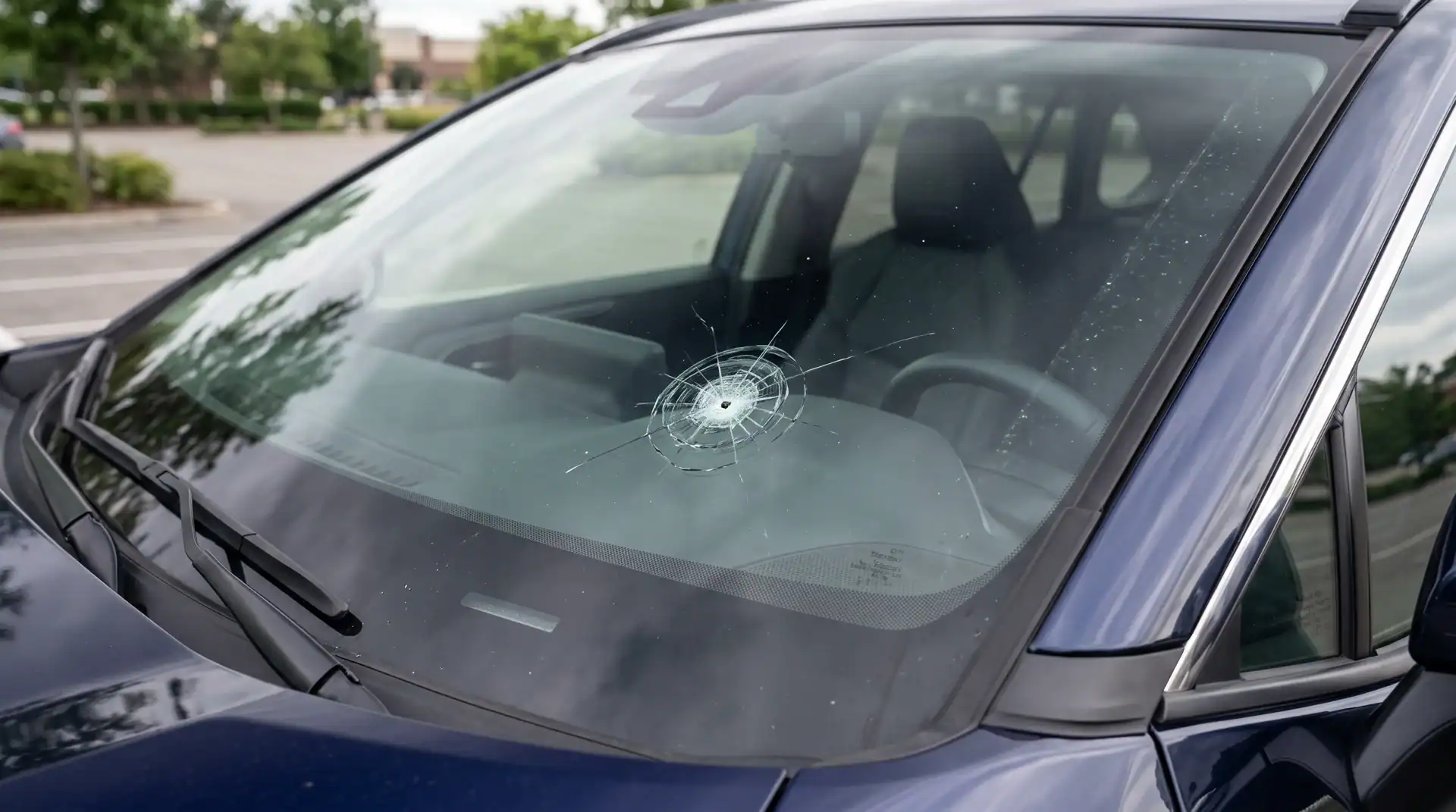
A crack in an RV windshield acts differently than the same one in a car, and this is where many owners get burned.
Coaches flex.
Every mile of I-90 through the Fourth of July Pass puts torsional load through a body that’s twenty-eight feet long and sitting on a chassis with meaningful frame flex, and that load transfers straight into the glass.
A six-inch crack in March becomes a full-span crack by June. Once it runs edge to edge, you’ve lost the repair option entirely, and you’re in replacement territory on a panel that may take three weeks to source.
There’s another cost people miss.
Comprehensive coverage on a motorhome policy usually treats glass the same way an auto policy does, but if the crack has been there for two seasons and the claim reads as neglected maintenance, the adjuster has an argument. Filing early, while it’s clearly impact damage, is worth more than any discount you’ll negotiate later.
Who This Is Actually For
Class A owners with split curved windshields— the hardest sourcing category and the one most shops decline outright. Vintage restorers working on anything pre-2005, where the original fabricator is out of business, and the coach builder’s parts line is long gone. Class C owners on Ford E-Series and Chevy cutaway chassis, where the cab glass is easy but the overcab and side glass often isn’t.
If you’ve got a mobile command unit, a specialty rig, or converted equipment sitting down because of a panel nobody stocks, that’s the same sourcing problem wearing different paint.
What all of these have in common is that the job is worth more in downtime than it is in glass. A coach that can’t leave the driveway in July costs you the trip you booked.
Why We Take the Jobs That Don’t Pencil Out Fast
Discontinued RV installations aren’t the best jobs for a glass shop compared to car windshields.
The sourcing hours aren’t billable in any clean way, and the install takes longer because gasket-set glass on a curved cap doesn’t forgive rushing.
We still do it, and the reason is unglamorous. Aaron’s been running his shop since 2004, and in twenty-one years the RV work is what helped build the referral base — because it’s the category where somebody remembers who said yes. A Class A owner who got an RV windshield nobody else could find tends to tell every other owner in his orbit.
We come to you for it, too, with no mileage markup inside the service area. That matters more on a coach than a car, since most owners aren’t excited about driving a cracked forty-foot rig across town to sit in a lot.
What to Have Ready Before You Call
Get your coach builder and model, the coach model year (not the chassis), along with a photo of the full windshield from about fifteen feet back so we can see the split and the curvature.
When the old glass is still in place, a close photo of the DOT stamp in the lower corner will shorten our search considerably. Measurements also help a lot, but aren’t required on the first call.
Then Give Us the Honest Timeline of Your Season
If you’re heading to Montana in 6 weeks, it will change which sourcing paths we chase first.
We’d rather work backward from your trip than hand you a part number and a shrug.
Discontinued doesn’t mean gone. It means the glass fell out of the channel that normal lookups search, and somebody has to make some calls to find where it landed. That’s the whole difference between the shops that quote RV windshields for replacement and the ones that don’t.
If you’ve already been told the glass doesn’t exist, call our WA line at (509) 892-6699 or the Idaho line at (208) 640-0549 with your coach builder and model year.
We’ll tell you what we can find and roughly how long it’ll take — including if the answer really is no. Or use our contact form if you prefer to contact us online.